



Government Reinstates Cambodian Traffic Law Enforcement After Rise in Dangerous Road Accidents
If you’ve driven in Cambodia recently and thought, “Huh… things feel a bit extra-lawless out here,” you probably weren’t imagining it.
After a 160 day pause, the Cambodian Government has officially reinstated nationwide Cambodian traffic law enforcement for pretty expected reasons: road accidents went up while the rules weren’t being strictly enforced.
Here’s what happened, why Cambodian traffic law enforcement was paused to begin with, and what it means for locals, expats, and travellers attempting to safely navigate Cambodian roads in 2026.
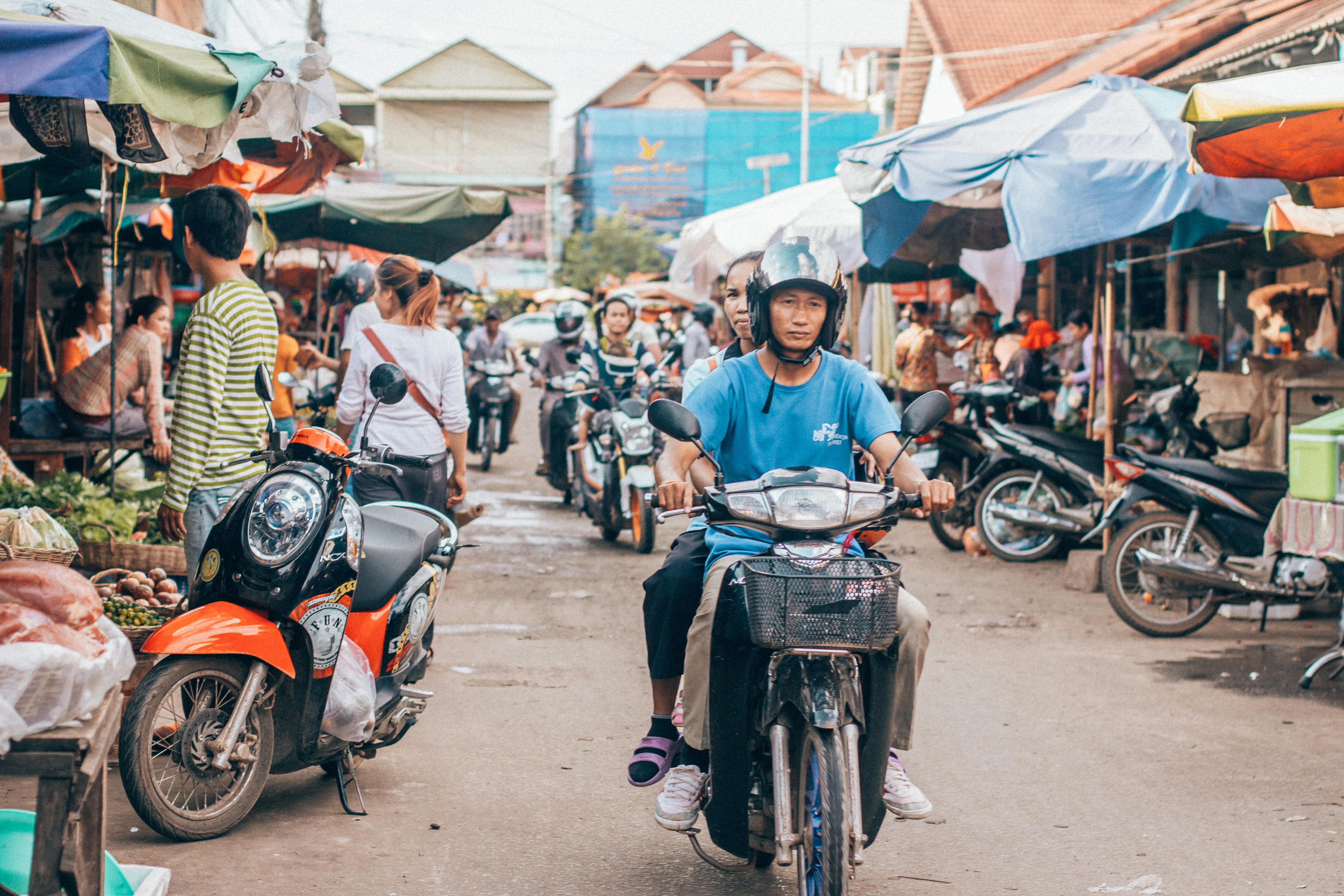
Why Did the Government Stop Enforcing Cambodian Traffic Laws?
Traffic enforcement wasn’t paused for fun or because officials suddenly trusted everyone to behave (we all know how that would go).
The suspension, which lasted from July 25 to December 31, 2025, was linked to tensions along the Cambodia/Thailand border. During this period, authorities shifted focus and resources due to the situation in the border area, and Cambodian traffic law enforcement was significantly reduced whilst officials redirected their efforts towards the border.
Some enforcement was partially brought back in certain areas in December, but it wasn’t until February 2026 that the General Commissariat of National Police announced a full nationwide return to stricter traffic enforcement. A move we welcome!
What Happened During the Cambodian Traffic Law Enforcement Pause?
Short version: more crashes, more injuries, more deaths. I’m going to take this time to say we need to take all statistics on this matter as general indications and not a pure representation, as data reporting can be spotty and many incidents go unreported.
Police data showed that during the 160 day period in 2025 without full enforcement:
- (REPORTED) Traffic accidents increased by 3% (that means 34 more accident cases than the same period in 2024)
- 62 deaths were recorded
- 209 injuries
And things didn’t magically improve in the new year either, if you were wondering.
In January 2026 alone:
- Accidents rose nearly 20% compared to January last year
- 42 accident cases
- 25 deaths
- 64 injuries
Those aren’t small numbers – especially in a country where many people travel by motorbike with very little physical protection beyond a helmet (if they’re wearing one at all). Most traffic accidents that don’t end with death or serious injury will go unreported, as will some that do.
According to Cambodian traffic law enforcement, the following graph shows the causes of reported accidents. Again, please note that many traffic accidents go unreported or do not have police presence at the scene (I’m not going to stop saying this, as it’s very relevant!). It’s also very difficult to get accurate data for this in Cambodia, but the graph should give you a rough idea of the issues.
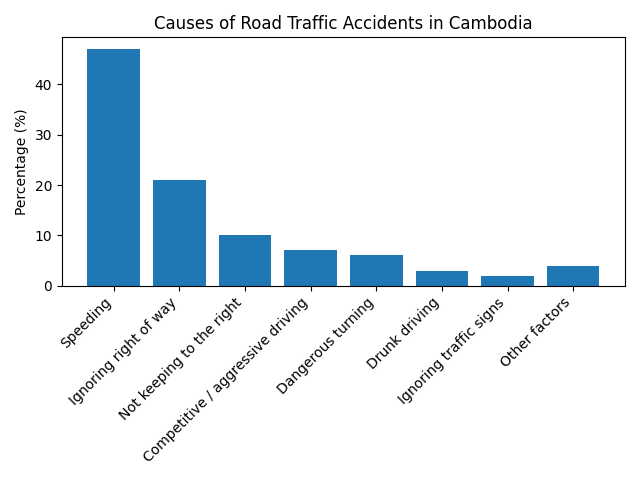
So yes, speeding is the clear villain here and is responsible for nearly half of officially reported accidents. If you’ve ever seen someone blast past you on a city road like they’re late for a Fast & Furious audition, that statistic probably doesn’t surprise you. There’s also a significant amount of drunk driving, which will usually go unreported unless it ends in a serious accident. In recent years, government officials in charge of Cambodian traffic law enforcement have made many steps towards curbing drink drive behaviour and punishing those who ignore the law.
Helmet Use (Or lack thereof) is Still a Major Issue
Road safety experts say that beyond speed and alcohol, not wearing helmets remains one of the biggest risk factors for serious injury and death in Cambodia.
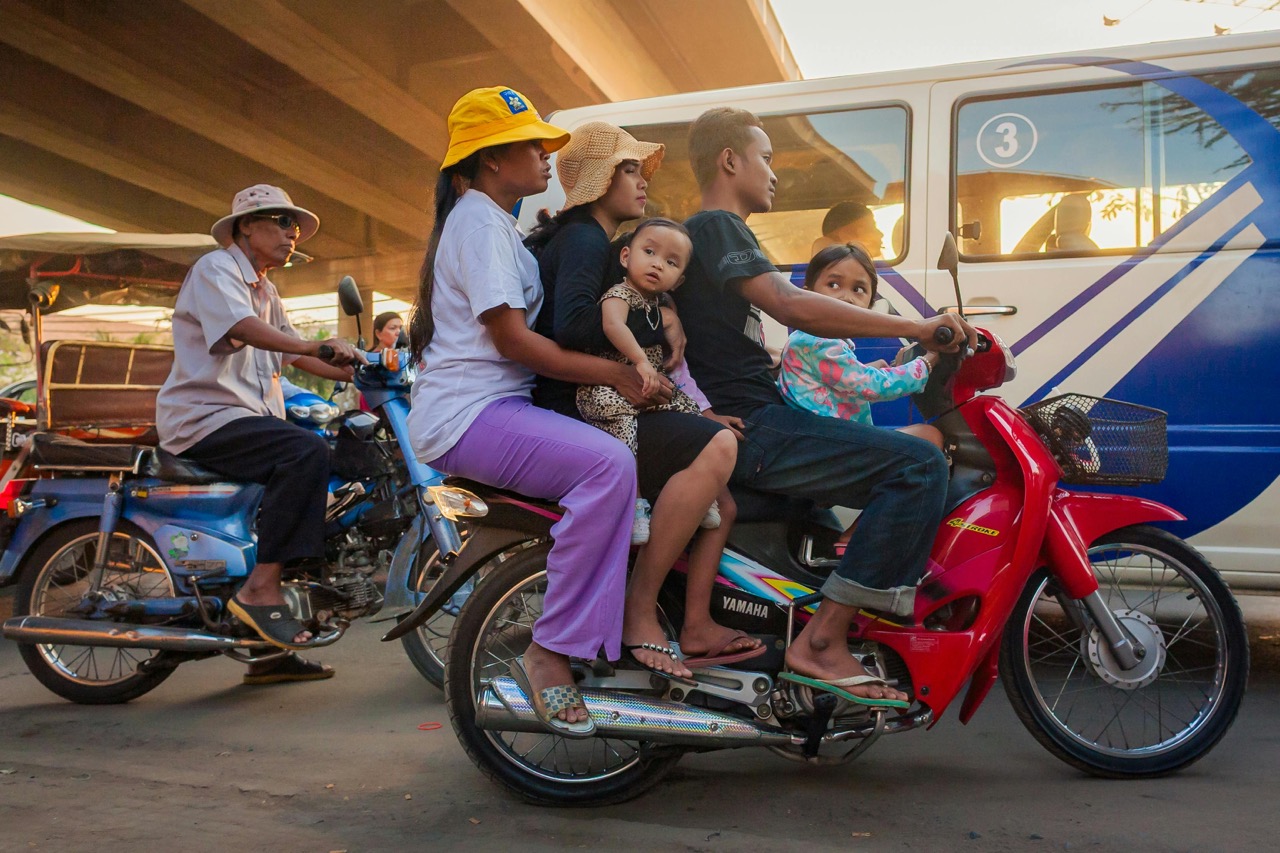
Motorbikes are the main form of transport for millions of people, yet helmet use – especially for passengers and people on short “just down the road” trips – is still inconsistent. It’s one of those “I’ll be fine, it’s only 2 minutes” decisions that can go very wrong, very fast.
With stricter enforcement back, helmet checks are expected to become more common again, particularly in cities. Don’t be surprised to see the return of police checkpoints, where people violating helmet laws will receive on-the-spot fines.
It is a legal requirement to wear a helmet as a driver or passenger of any motorbike/scooter in Cambodia, punishable by a fine.
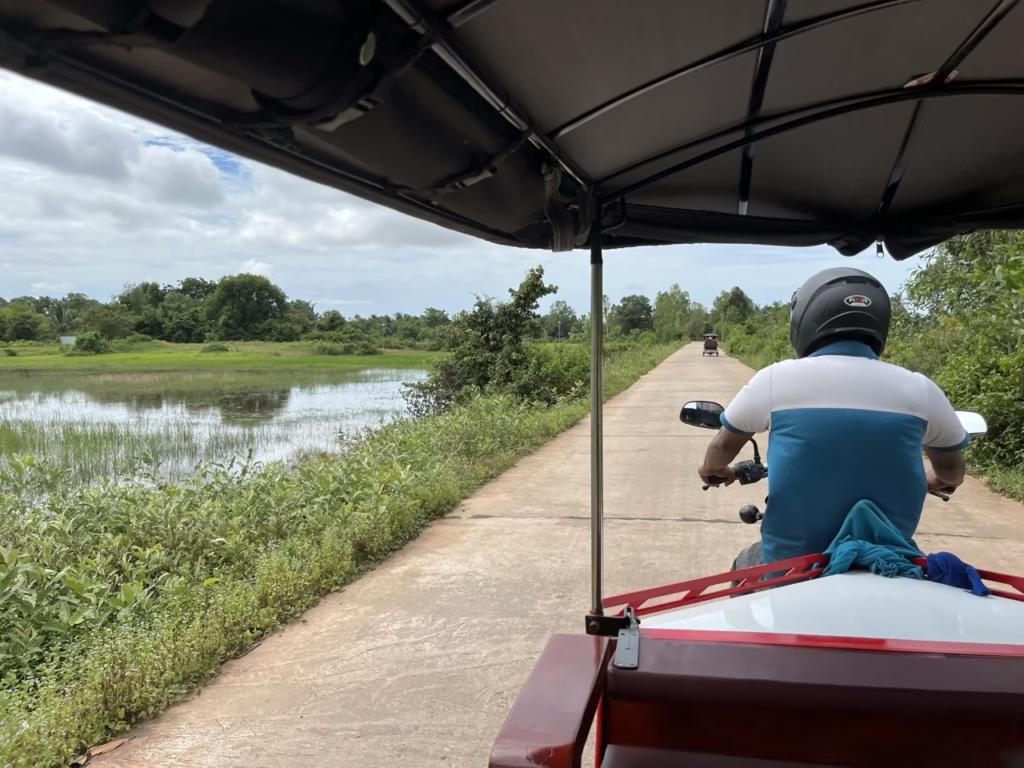
What the Government Is Saying
The National Police say the renewed enforcement push is aimed at making Cambodia’s roads safer, more orderly, and less deadly for drivers, riders, and pedestrians. Alongside stricter enforcement, there is also a strong focus on raising public awareness about traffic laws and responsible road use, with the overall goal of reducing accidents, deaths, injuries, and damage to both public and private property.
The slogan behind the campaign is basically: no accidents today, none tomorrow either.
Ambitious? Yes. Needed? Also yes. We think it’s great that officials are hoping to improve the amount of people adhering to Cambodian traffic law through education and awareness campaigns.
Special Concern : School Zones
Road safety experts, including the group Asia Injury Prevention (AIP), are urging authorities to focus enforcement in school zones.
Research has found that in some school areas, drivers have been recorded doing incredibly excessive speeds of 80-90 km/h, with some cases reported of drivers going over 100 km/h.
Near schools. Where children are walking. Let that sink in!
Targeted enforcement of Cambodian traffic law around schools is seen as one of the most important steps to prevent child injuries and deaths on Cambodian roads.
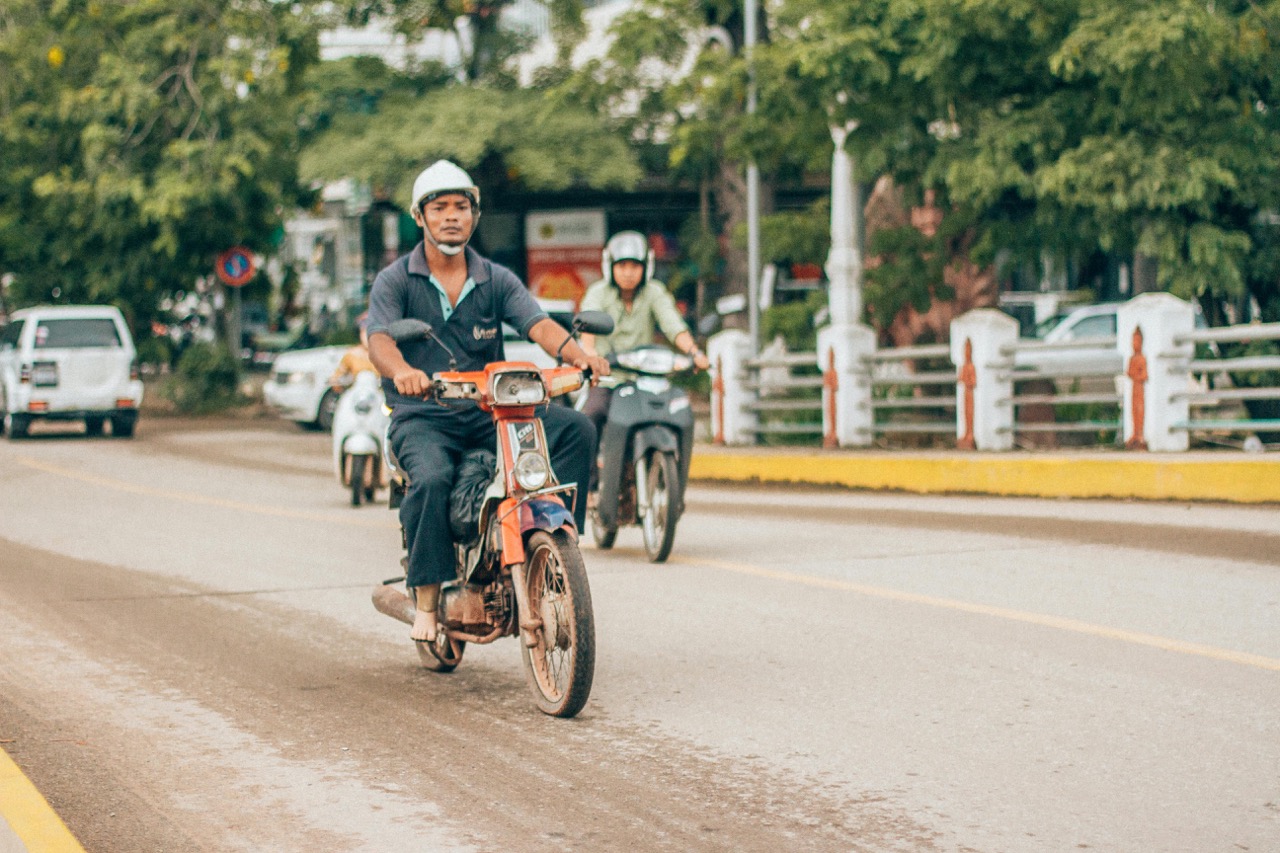
Calls for Fair & Professional Enforcement of Cambodian Traffic Law
Experts aren’t just calling for more enforcement, they want better enforcement. There are strong calls for:
- Transparent use of road cameras
- Equal application of the law
- Strong professional ethics among traffic officers
- Punishment for inappropriate behaviour by officials
- Recognition for officers who do their job properly
In short: enforce the rules, but do it fairly and consistently so the public actually supports it. Sounds great!
What This Means for Drivers, Riders & Travellers
If you’re driving or riding in Cambodia right now, whether you’re a local resident, expat, or tourist exploring the country – you should expect a noticeable increase in traffic stops, stricter helmet checks, and a much heavier focus on speeding and general road rule enforcement. With Cambodia traffic law enforcement now fully back in action, basic things like obeying road signs, staying in your lane, and actually wearing a proper helmet are no longer “maybe I’ll get away with it” situations.
Ignoring the rules is dangerous, not just for your wallet in the form of fines, but for your personal safety on Cambodia’s busy and often unpredictable roads.
Bringing back traffic law enforcement isn’t just about fines – it’s about reducing a very real and very preventable toll of injuries and deaths on Cambodian roads. And honestly, if it means fewer high speed motorbike fly-bys that make you question your life insurance situation, that’s probably a good thing.
If you’re driving or riding in Cambodia, now’s a good time to slow down, wear a proper helmet, and remember: the traffic police are officially back in business.
👉 RELATED ARTICLE : “Renting a scooter in Siem Reap”
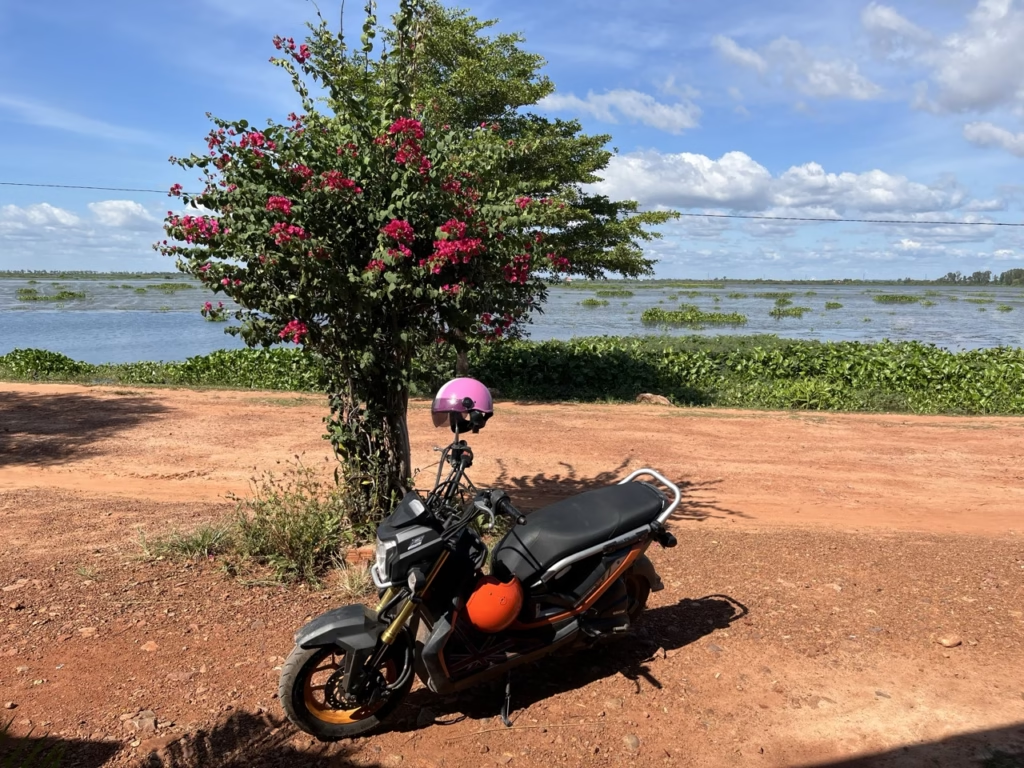
And here’s a beautiful image of the first Honda Zoomer I owned – you’re welcome. 👇
For more great information or recommendations from our Siem Reap travel guide and for tips on Cambodia in general, don’t forget to follow our Instagram, Facebook, YouTube and TikTok accounts for regular fun and updates!
@morethantemples
Thinking about a trip to Cambodia and looking for someone to help plan your itinerary, or just looking for someone to take you to places you won’t find on regular tours? CLICK HERE to visit our “Tours” page and get in touch. Nightlife tours also available!
Any information in the article above about Cambodian traffic law enforcement was correct at the time of posting to the best of our knowledge. If you notice any issues or would like to chat to us about the article please get in touch with us via our “ABOUT” page. If you’re the owner of a business we’ve written about and would like to discuss any out of date or incorrect information, please get in touch and we’ll be more than happy to help! Any opinions expressed in our articles are our own and may not be representative of everyone’s experience.
If you found this article helpful, please consider heading to our ABOUT page by CLICKING HERE, and leaving us a tip via BuyMeACoffee!